Product Overview
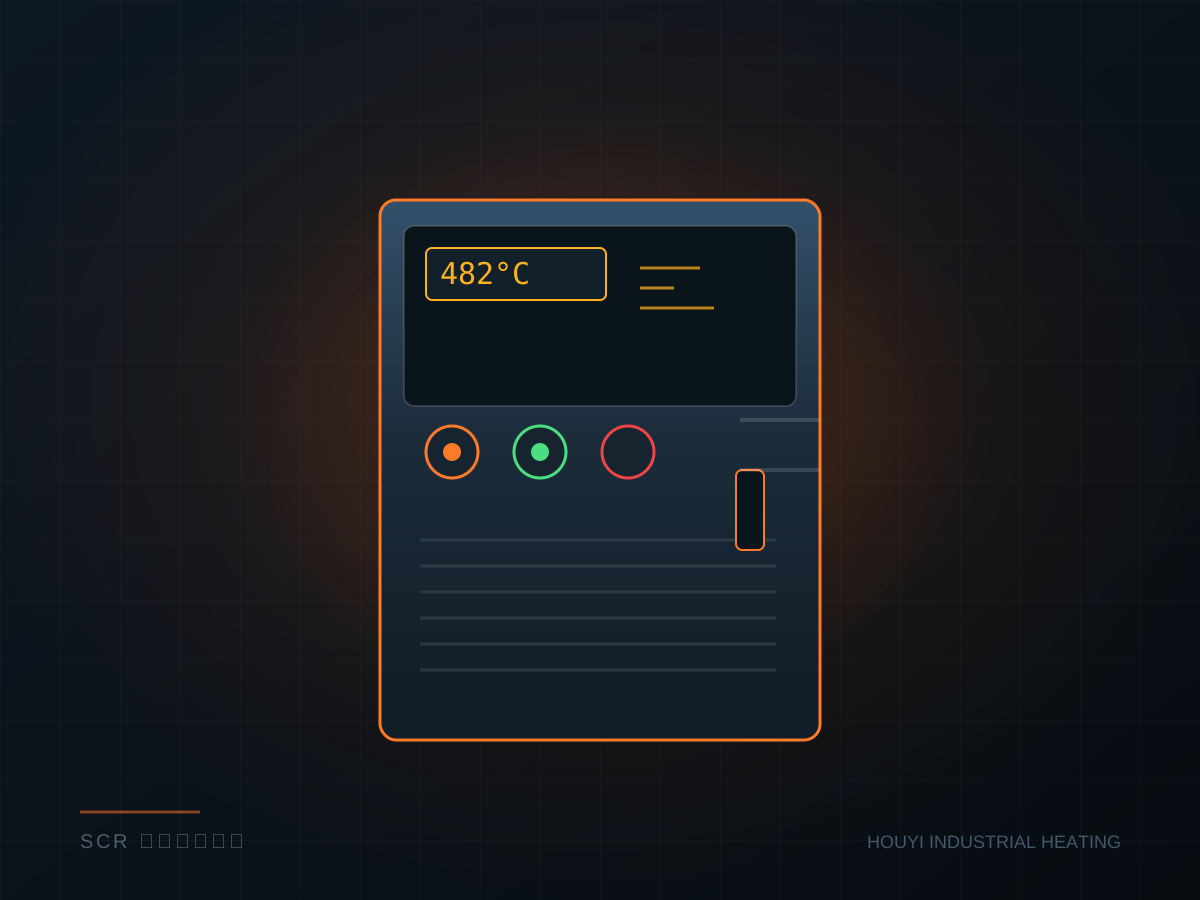
Large heating circuits using contactor on/off control see inrush of 6–8× rated current, and frequent switching shortens contact life. The SCR cabinet replaces contactors with anti-parallel thyristors, continuously regulating output by phase-angle or zero-crossing control—current rises smoothly and temperature accuracy reaches ±0.5°C.
Phase-angle responds fast but generates harmonics, suiting smaller loads or harmonic-tolerant sites; zero-crossing switches by whole cycles with minimal harmonics, ideal for large resistive loads. The cabinet has fast fuses, RC snubbers, and cooling fans; thyristors mount on aluminum heat sinks with forced air triggered above 75°C.
Control signals support 4–20 mA, 0–10 V, and RS485 Modbus. Multi-zone control regulates each loop independently to avoid interaction. Enclosure is IP54, with optional dust filter for dusty sites; for explosion protection use pressurized purging or flameproof construction.
Construction Features
- Phase-angle / zero-crossing selectable, continuous output
- Smooth inrush, less grid impact
- Temperature accuracy up to ±0.5°C
- Fast fuse + RC snubber protect thyristors
- Supports 4–20 mA, 0–10 V, RS485 Modbus
- Independent multi-zone control, 1 – 12 loops
Technical Specifications
| Control Power | 10 – 400 kW |
|---|---|
| Rated Voltage | 380V / 415V, 3-phase |
| Control Mode | Phase-angle / zero-crossing control |
| Control Signal | 4–20 mA / 0–10 V / RS485 |
| Control Accuracy | ±0.5°C |
| Cooling | Forced air (triggered ≥75°C) |
| Protection | IP54 (upgradeable to IP65) |
| Loops | 1 – 12 loops |
The table lists typical configuration ranges. Special pressure, temperature or media conditions require re-checking; final parameters are confirmed by the approved drawings and technical agreement.
Typical Applications
- Thermal-oil boiler power control
- Duct heater continuous control
- Laboratory electric furnaces
- Multi-zone mold control
- High-power ovens
Information Needed for Selection
- Medium name, concentration, and whether it contains particles
- Total medium volume or circulation flow rate
- Initial and target temperature
- Required heat-up time
- Vessel or pipe size and material
- Supply voltage, phases, and available capacity
- Installation environment and hazardous-area requirements
- Connection standard and mounting orientation