Product Overview
Infrared heating does not rely on air convection; energy reaches the workpiece as electromagnetic waves and converts to heat upon surface absorption. Medium-wave IR (1.4–3 μm) is strongly absorbed by water, coatings, and plastics, making it the common band for drying and softening.
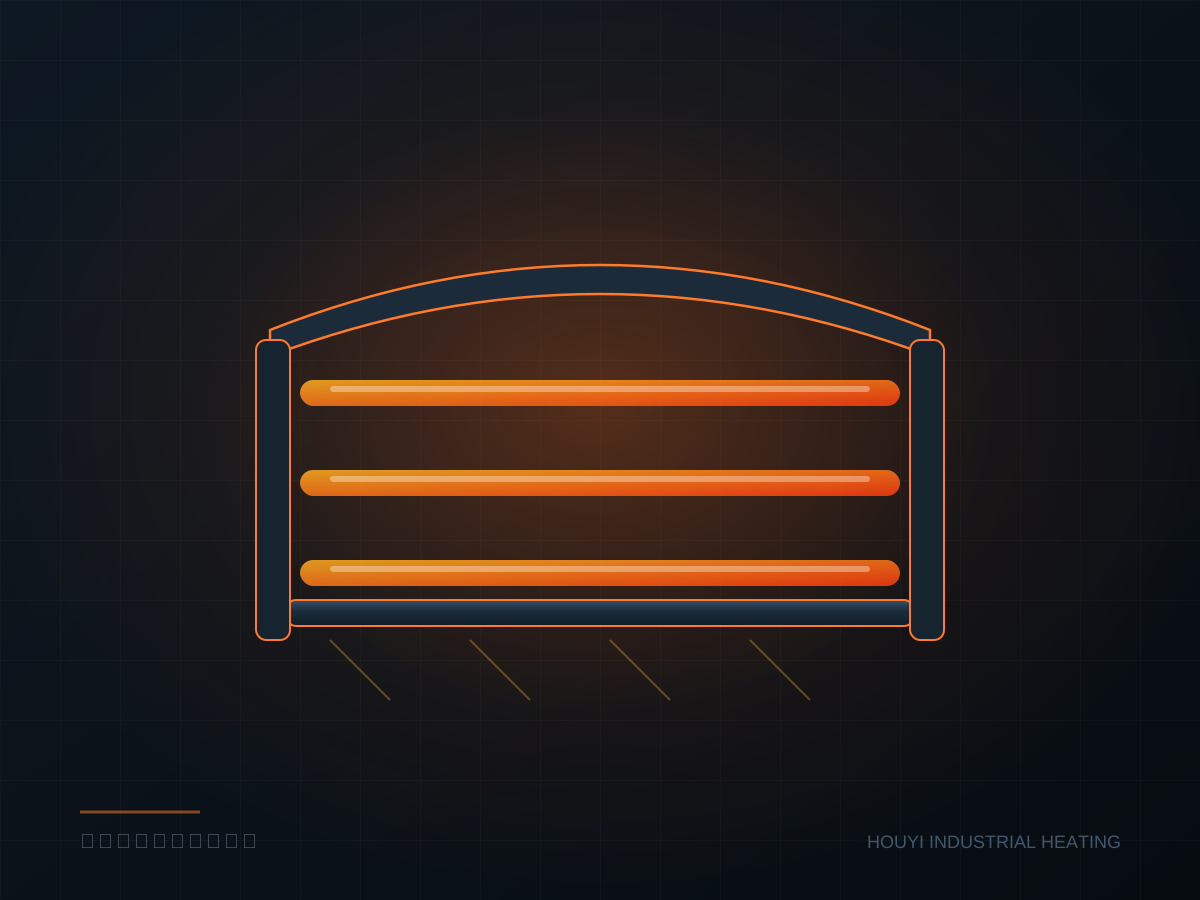
The HYI module comprises a gold-plated or ceramic reflector, halogen or quartz tubes, and an aluminum-profile frame. The reflector bounces back radiation away from the workpiece, raising effective utilization above 70%. Tube surface temperature is 600–900°C and cold-start to full power takes only seconds—ideal for intermittent processes needing rapid switching.
Mounting distance is typically 150–400 mm; closer gives higher power density but poorer uniformity. Side-by-side modules are zoned by workpiece width with IR pyrometer or thermocouple feedback. Solvent-based coatings require exhaust to prevent vapor accumulation near the tubes.
Construction Features
- Medium-wave IR 1.4 – 3 μm, high absorption by water and coatings
- Gold-plated reflector, radiation utilization ≥70%
- Cold start to full power in 3 – 5 s, low thermal inertia
- Modular aluminum frame, joinable to workpiece width
- Zoned control with IR pyrometer closed-loop regulation
- Air- or water-cooled options for continuous duty
Technical Specifications
| Single Power | 0.5 – 6 kW |
|---|---|
| Rated Voltage | 220V / 380V |
| Wavelength | 1.4 – 3 μm (medium-wave) |
| Element Surface Temp | 600 – 900°C |
| Reflector | Gold-plated quartz / ceramic coating |
| Mounting Distance | 150 – 400 mm |
| Power Control | Phase-angle control / zero-crossing control |
| Cooling | Natural cooling / forced air cooling |
The table lists typical configuration ranges. Special pressure, temperature or media conditions require re-checking; final parameters are confirmed by the approved drawings and technical agreement.
Typical Applications
- Coating and ink drying
- Plastic sheet softening
- Glass and film heating
- Textile printing/dyeing drying
- Electronic component curing
Information Needed for Selection
- Medium name, concentration, and whether it contains particles
- Total medium volume or circulation flow rate
- Initial and target temperature
- Required heat-up time
- Vessel or pipe size and material
- Supply voltage, phases, and available capacity
- Installation environment and hazardous-area requirements
- Connection standard and mounting orientation