Product Overview
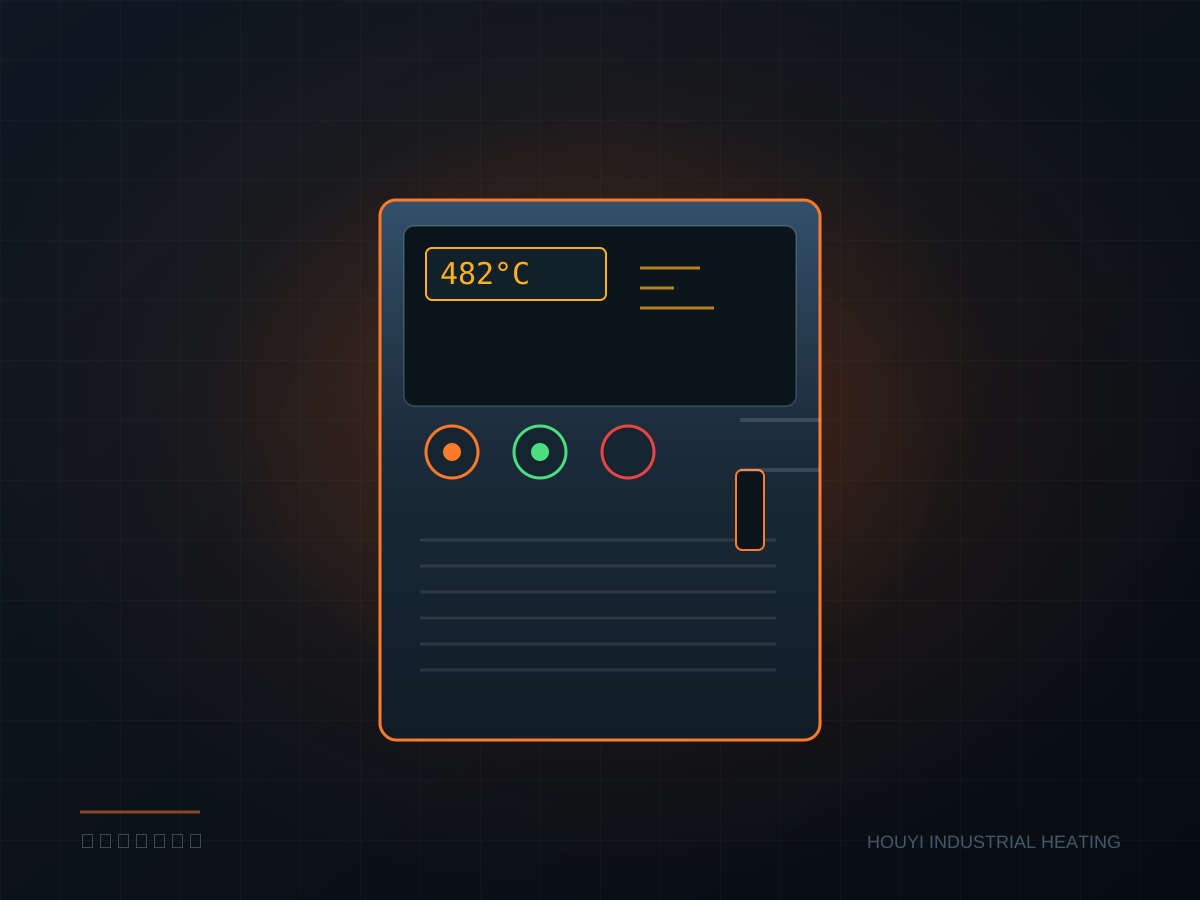
The explosion-proof control panel integrates breakers, contactors, solid-state relays, temperature controllers, over-temperature protection, and terminal blocks in a flameproof enclosure built to Exd IIB T4 or IIC T6, suitable for Zone 1 and Zone 2 hazardous areas. The terminal and component chambers are separate, so service need not break the main circuit.
Each heating circuit has its own breaker and contactor; the main circuit adds fast fuses for short-circuit protection. Control uses a dual-loop design: the master loop uses PID via SCR or contactor; the safety loop uses an independent limit thermostat that cuts the main contactor directly on over-temperature—no reliance on software logic.
The enclosure is cast aluminum alloy or painted carbon steel, IP65, with stainless hinges and exposed bolts. Explosion-proof cable glands provide entry; mismatched cable OD requires a different seal ring. Before shipment it passes insulation, hi-pot, and ground-continuity tests, with a copy of the explosion-proof certificate and wiring diagram supplied.
Construction Features
- Flameproof Exd IIB T4 / IIC T6, for Zone 1 and Zone 2
- Independent master and safety loops; over-temp directly cuts main contactor
- Independent breaker, contactor, and fast fuse per circuit
- Cast-aluminum or painted carbon-steel enclosure, IP65
- Explosion-proof cable glands; terminal and component chambers separated
- Optional SCR control, multi-zone, and remote communication
Technical Specifications
| Control Power | 5 – 200 kW |
|---|---|
| Rated Voltage | 380V / 415V, 3-phase 4-wire |
| Explosion Protection | Exd IIB T4 / Exd IIC T6 |
| Protection | IP65 |
| Enclosure Material | Cast aluminum / painted carbon steel / 304 |
| Control Method | PID + contactor / SCR control |
| Control Circuits | 1 – 12 circuits |
| Communication | RS485 / Modbus RTU (optional) |
The table lists typical configuration ranges. Special pressure, temperature or media conditions require re-checking; final parameters are confirmed by the approved drawings and technical agreement.
Typical Applications
- Petrochemical plant heating control
- Oil & gas wellhead and gathering stations
- Solvent and coating workshops
- Dust explosive environments
- Offshore platforms
Information Needed for Selection
- Medium name, concentration, and whether it contains particles
- Total medium volume or circulation flow rate
- Initial and target temperature
- Required heat-up time
- Vessel or pipe size and material
- Supply voltage, phases, and available capacity
- Installation environment and hazardous-area requirements
- Connection standard and mounting orientation