Technical Article
How to Calculate Heater Power: Working Back from Heat-Up Time to kW
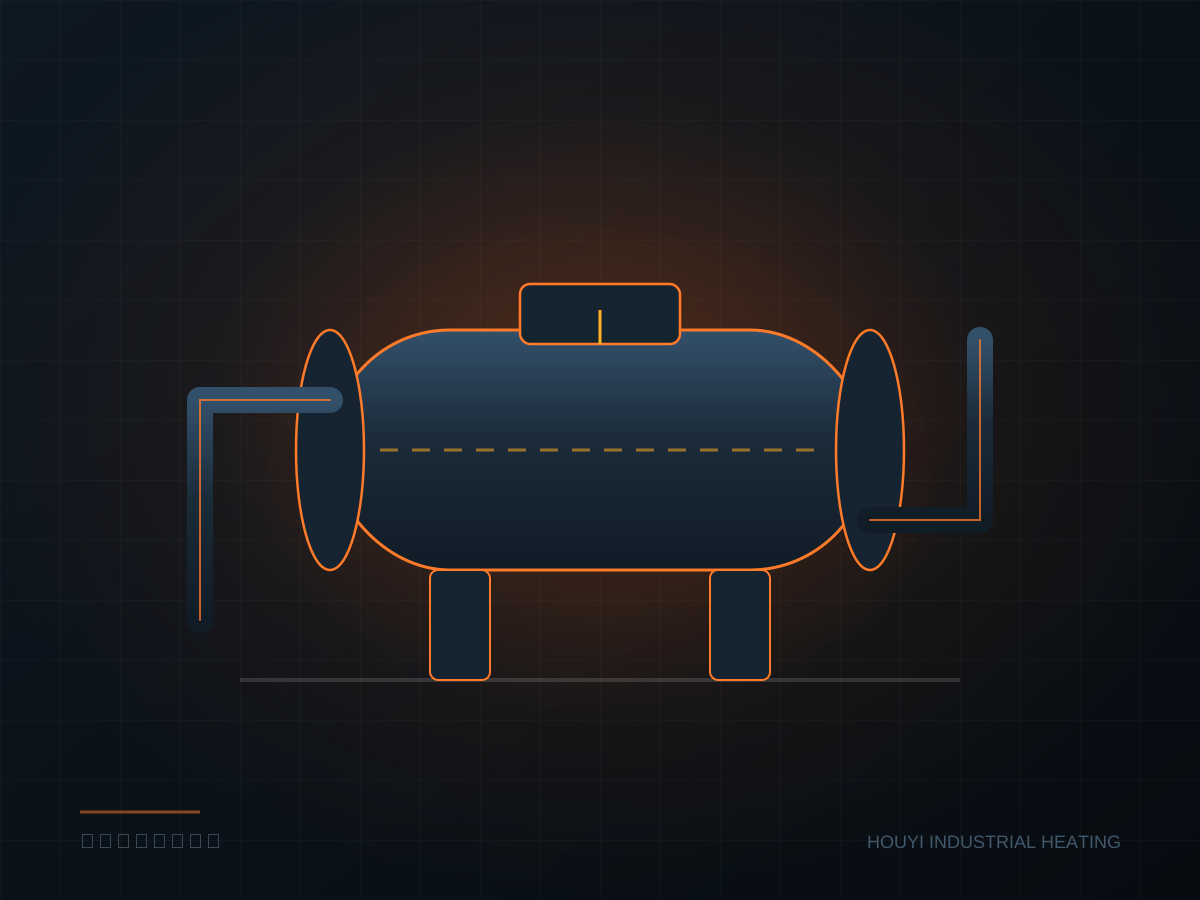
Many inquiry sheets only say "heat to 80°C" — with no medium mass, no heat-up time, no starting temperature, and no tank insulation. Without these parameters, any quoted power is a guess.
Step 1: Calculate the useful heat
The heat needed to raise the medium from its starting temperature to the target is the product of mass, specific heat and temperature difference. Water at ambient has a specific heat of about 4.2 kJ/(kg·°C), thermal oil about 2.0, and steel only about 0.5.
Example: a tank holding 2 tonnes of water, heated from 15°C to 85°C, needs 2000 × 4.2 × 70 = 588,000 kJ of useful heat.
Step 2: Decide the heat-up time
The same heat over 2 hours or 6 hours gives a threefold difference in power. Divide the kJ by seconds to get kW:
588,000 kJ ÷ 7200 s ≈ 81.7 kW
That is the theoretical value. Real selection must also account for tank heat loss, the heat absorbed by piping and supports, and surface evaporation. For a steel tank with piping, add 10%–15% of the water weight; an uninsulated tank loses roughly 1.5–2 kW per square metre of surface.
Step 3: Add margin — but not blindly
The usual practice is to add 15%–20% to the theoretical value. In the example above, 81.7 kW plus 20% is about 98 kW, so 100 kW is a sensible choice.
More margin is not better. Oversized power raises element surface load, and oil media tend to coke; control also falls back on frequent on/off switching, which actually increases fluctuation. If you are worried about winter conditions or future expansion, the better approach is to split into groups — e.g. four 25 kW groups switched in as needed — rather than sizing to 150 kW up front.
Holding power is a separate calculation
Once at temperature, the power needed to maintain it is far less than the heat-up power — typically only 15%–25% of it. If the equipment runs most of the time in holding mode, this is the main long-term electricity cost.
A 5 m³ oil tank with no insulation, surface at 70°C and ambient at 20°C, loses roughly 4–6 kW through natural convection and radiation. With 50 mm rock-wool insulation this drops below 1 kW. The insulation usually pays for itself within a year of electricity savings.
Flow systems are calculated differently
For continuously flowing media you do not calculate total heat but enthalpy difference:
P(kW) = flow (kg/s) × specific heat (kJ/kg·°C) × ΔT (°C)
For 5 m³/h of water heated from 20°C to 60°C, the flow is about 1.39 kg/s, so the power is 1.39 × 4.2 × 40 ≈ 233 kW. These duties have high power density, so element surface temperature must be checked to avoid localized boiling at the tube wall.
What to give the manufacturer
- Medium name, concentration, whether it contains particles or scales easily
- Total medium mass or flow rate
- Starting and target temperature
- Required heat-up time
- Tank dimensions, material, and whether insulated
- Power supply: voltage, phases, available capacity
- Environment: indoor/outdoor, corrosive gases, whether a hazardous area
Write these down clearly and the selection usually lands right the first time.